Let us be absolutely honest: the heart of any Indian home is its kitchen, but keeping it organised can feel like an endless battle. If you are living in a compact 1BHK or 2BHK apartment in cities like Mumbai, Bengaluru, or Delhi, you know exactly what I mean. Every morning begins with a flurry of activity, from the rhythmic whistle of the pressure cooker to the aromatic splutter of mustard seeds in hot oil. While our culinary traditions are rich and beautiful, they are also incredibly demanding on physical space. We do not just cook; we grind, we steam, we deep fry, and we slow-cook, requiring an army of heavy-duty appliances and unique cookware to get the job done.
When you open a typical Western home design magazine or browse global organisation boards, you are often greeted with minimalist kitchens featuring empty countertops, a single decorative olive oil bottle, and neat rows of identical baking ingredients. That aesthetic is lovely, but it simply does not hold up to the reality of Indian cooking. We do not just have flour and sugar; we have three types of rice, six varieties of lentils, an array of whole and powdered spices, heavy cast-iron kadhais, flat tawas, and bulky stone mixers. A small Indian kitchen requires a highly specialized organizational strategy that respects our ingredients, our cooking methods, and our local climatic challenges.
Over the years, I have helped friends and family transform their cramped cooking areas into efficient, stress-free zones without breaking the bank. In this guide, we are going to dive deep into highly practical, field-tested small kitchen organisation ideas designed specifically for Indian households. Whether you are living in a rented flat with rigid landlord rules or planning a budget-friendly renovation with modular systems from brands like Sleek by Asian Paints or Godrej Interio, these actionable tips will help you reclaim your space and bring joy back to your daily cooking routine.
The Unique Ecosystem of an Indian Kitchen
To solve the storage puzzle, we first need to understand the unique challenges of our kitchens. The first major hurdle is the sheer volume of dry goods we store. Unlike Western households that buy pre-packaged, single-use portions, Indian families prefer buying staples like atta, rice, and dals in bulk, often in quantities ranging from five to twenty kilograms. This requires heavy-duty deep storage solutions that are insect-proof and moisture-proof, especially during the humid monsoon months when pantry pests like weevils can ruin expensive ingredients.
The second challenge is what I call the tadka residue. The oils and spices we use are highly aromatic but they also create a sticky, stubborn film of grease when steam carries oil particles into the air. If you have open shelves near your stove, you already know that they quickly become coated in dust and oil, requiring frequent, exhausting scrubbing. Therefore, any open storage we introduce must be carefully positioned away from the primary cooking zone, or made of materials that are incredibly easy to wipe down.
Lastly, we must address our heavy cookware. Our beloved cast-iron tawas, heavy aluminum pressure cookers, and stone mortar and pestles cannot simply be stacked haphazardly. They are heavy, they can scratch delicate glass cooktops, and pulling them out from the back of a deep lower cabinet can easily strain your back. Our layout needs to prioritize accessibility based on the frequency of use, ensuring that the items you reach for daily are within arm's reach, while the special festive brass platters are stored safely out of the way.
1. Maximize Your Vertical Real Estate
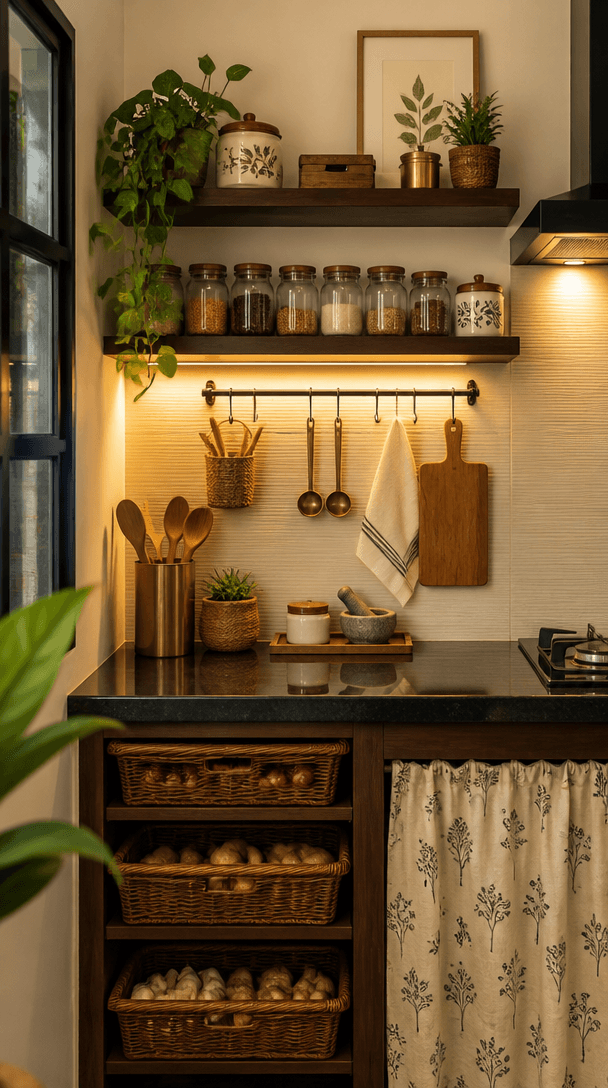
When floor and counter space are at a premium, the only way to go is up. Most builders in India provide a standard granite countertop with a row of cabinets underneath and perhaps one or two overhead cabinets, leaving a vast expanse of empty wall space in between. This backsplash area is absolute gold dust for a small kitchen. Instead of leaving it bare, consider installing stainless steel utility rails with adjustable hooks. These rails are incredibly sturdy and can hold your daily-use ladles, spatulas, wooden spoons, and even small frying pans.
If you are renting and your landlord does not allow drilling into expensive wall tiles, do not worry. You can find high-quality, heavy-duty adhesive hooks or suction-based corner shelves that can hold a surprising amount of weight. For permanent homes, investing in a custom pegboard is a game-changer. You can paint the pegboard to match your walls using durable, washable emulsion paint like Asian Paints Apcolite, and then arrange hooks and small wooden shelves to hold everything from your tea strainers to small planter pots of fresh coriander.
Another brilliant vertical trick is to install floating wooden shelves on empty walls that are far from the stove. Use these shelves to display your beautifully curated glass jars of colorful lentils, dry fruits, and whole spices. This not only frees up valuable cabinet space but also adds a warm, rustic charm to your kitchen. Just remember to keep a step stool handy so that you can easily access the highest shelves without straining.
2. Smart Cabinetry Retrofits and Corner Solutions
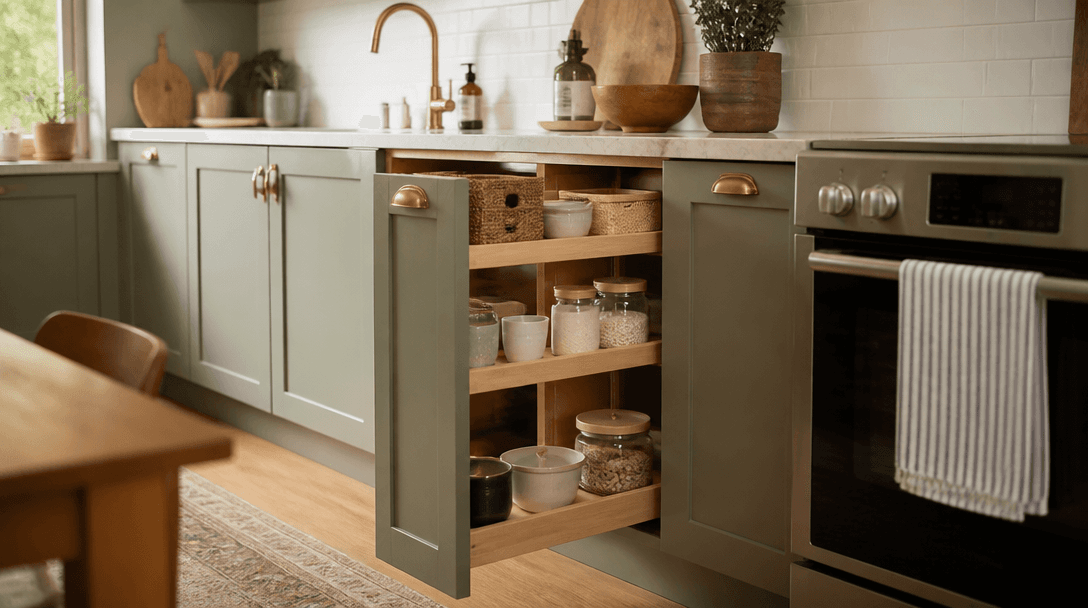
Deep, dark base cabinets are the ultimate enemies of organisation. Things go in, slide to the back, and are never seen again until they expire. In a small kitchen, every square inch must work for its living. If your budget allows for a minor upgrade, consider retrofitting your existing swing-door cabinets with pull-out wire baskets or sleek tandem drawers. Brands like Sleek by Asian Paints offer excellent modular drawer systems that can be customized to fit your existing cabinetry carcasses. A smooth pull-out drawer brings all your pots and pans out into the light, allowing you to access items at the very back with zero effort.
For L-shaped and U-shaped kitchens, the corner cabinet is often a massive dead zone where large, dusty cooking pots go to die. Traditional shelves in these corners are incredibly difficult to reach. To solve this, you can install specialized corner hardware like a Lazy Susan or a Magic Corner unit. These metal trays rotate or swing outwards when you open the cabinet door, bringing your heavy idli steamers and biryani pots directly to you. While professional corner hardware can cost anywhere from ₹8,000 to ₹18,000, it is an investment that instantly doubles your usable storage space.
If a complete drawer retrofit is outside your current budget, you can easily mimic the functionality using deep, narrow plastic bins that act as makeshift drawers. Simply group similar items together in these bins, label them clearly, and slide them onto your deep shelves. When you need something, you just pull the bin out like a drawer, grab what you need, and slide it back in. This simple hack costs less than ₹1,500 for a set of six bins and completely eliminates cabinet clutter.
Tackling the Under-Sink Chaos
The space directly under the kitchen sink is notoriously difficult to organize due to plumbing pipes, water purifier outlets, and dampness. Often, it becomes a chaotic pile of garbage bags, old scrubbers, and half-empty bottles of dish soap. Start by installing a simple two-tier expandable under-sink organizer rack, which is specifically designed to fit around drainpipes. This allows you to utilize the vertical space around the plumbing safely.
Next, mount a small plastic basket on the inside of the under-sink cabinet door to hold your daily scrub pads, garbage bags, and microfiber cloths. Keep this area dry by laying down a waterproof PVC liner sheet to protect the cabinet wood from water leaks. To combat the typical musty smell that accumulates here during the humid monsoon season, place a small tub of moisture-absorbing crystals or a bowl of activated charcoal at the back of the cabinet.
3. Streamlining the Prep and Cooking Zones
Efficiency in a small kitchen is all about reducing steps. The less you have to move around while cooking, the faster and more enjoyable the process becomes. This brings us to the golden concept of zoning. Divide your kitchen into three main zones: the Prep Zone (chopping and grinding), the Hot Zone (the cooktop and chimney), and the Wet Zone (the sink and dish drainer). Keep the tools and ingredients relevant to each zone close at hand.
Let us talk about spices, the soul of Indian cooking. If you are opening five different jars every time you cook a simple dal, you are wasting time and space. The humble, traditional Indian masala dabba is a masterpiece of functional design. By keeping your seven core daily spices (mustard seeds, cumin, turmeric, chili powder, coriander powder, garam masala, and salt) in one single, beautifully crafted stainless steel or brass container, you instantly free up cabinet space and speed up your cooking process. Keep this masala dabba in a drawer right next to or below your stove.
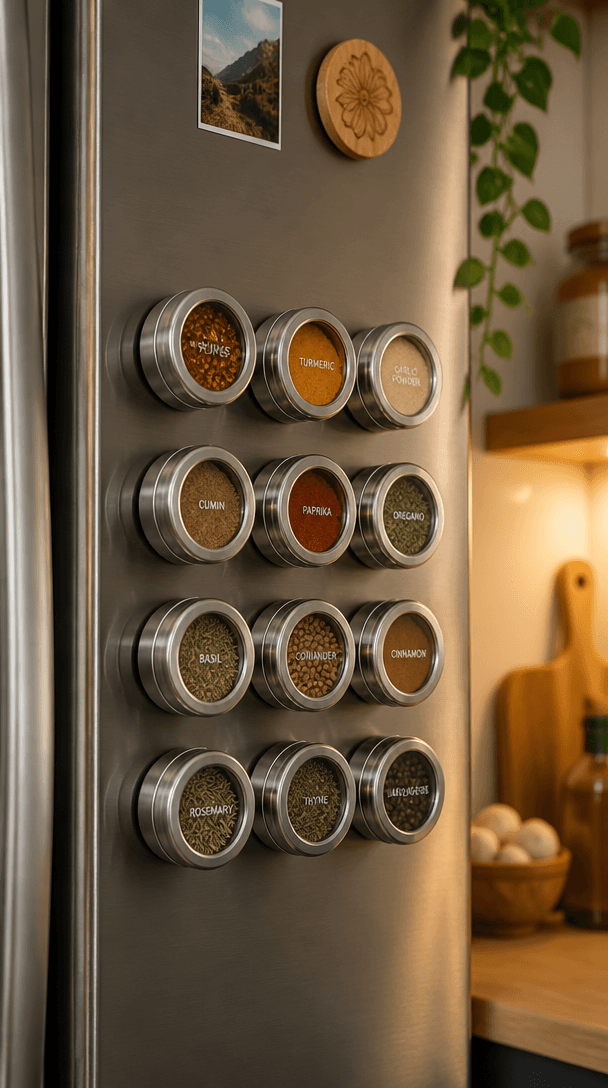
For secondary spices like cardamom, cloves, and bay leaves, use uniform glass jars stored on a slim, tiered spice rack that sits on your counter or hangs on the wall. Decanting your spices from their original plastic packets into matching containers immediately reduces visual noise, making a small space feel much larger and more organized. I highly recommend Borosil or local high-quality glass jars as they do not absorb stubborn spice odors or yellow stains over time.
Dealing with Heavy-Duty Cookware
Stacking pots and pans directly on top of each other is a recipe for chipped enamel, scratched non-stick coatings, and a lot of annoying clattering noises every time you search for a lid. Instead, invest in a vertical wire pan organizer rack. These simple metal stands allow you to store your heavy kadhais, frying pans, and tawas vertically, like books on a shelf. This means you can pull out your heavy iron tawa without having to lift three other heavy pots off the top of it.
For pot lids, which are notoriously difficult to store neatly, you can install a slim metal lid organizer on the inside of a cabinet door. This uses up completely dead space and keeps your countertops clean. If you have pressure cookers, store them with their lids flipped upside down on top of the cooker body, this simple trick allows you to stack another pot safely on top without damaging the pressure valve or the rubber gasket.
4. Reclaiming Your Countertop Space
In a small kitchen, clear countertop space is your most valuable asset. The moment your counters are cluttered with a mixer-grinder, a toaster, a roti maker, and drying dishes, you lose the physical space required to comfortably chop vegetables and prep meals. The rule of thumb is simple: if you do not use an appliance daily, it does not deserve a permanent spot on your countertop.
Take your mixer-grinder, for instance. An indispensable tool in any Indian kitchen for grinding fresh chutneys and batters, but a Sujata or Preethi mixie is also quite bulky. If you use it three times a week, store it in an easy-to-reach lower drawer or cabinet instead of keeping it on the counter. If you are designing your kitchen from scratch, you can incorporate an appliance garage, a dedicated cabinet at counter level with a rolling shutter door where you can slide your heavy appliances out of sight when not in use.
Another major countertop hog is the wet dish drying rack. Instead of a large plastic basket that sits permanently next to your sink, look for an over-the-sink steel dish drying rack. These clever structures span the width of your sink, allowing washed thalis, katoris, and glasses to drip-dry directly into the drain below, saving you valuable counter space while keeping your kitchen dry and neat.
5. Low-Cost DIY Hacks (Under ₹2,000)
You do not need to spend a fortune on high-end modular systems to achieve an organized kitchen. Some of the most effective organization tools are incredibly cheap and can be found at your local plastics shop or online. One of my favorite low-cost hacks is using tension rods. You can buy these small, spring-loaded metal rods for under ₹300 each and mount them vertically inside your cabinets. This creates instant dividers for storing your flat cutting boards, baking trays, and serving platters upright.
Another fantastic budget solution is using under-shelf wire baskets. These slide onto your existing cabinet shelves without any drilling, creating an extra hanging drawer underneath the shelf. It is the perfect place to store light items like kitchen towels, plastic wraps, packets of soup, or small snack boxes that would otherwise get lost in the depths of a tall cabinet.
Do not forget about the power of lazy susans for deep cabinet shelves. You can buy simple plastic turntable trays for around ₹400. Place them on your upper shelves and stack your daily sauces, vinegar bottles, and small spice jars on them. With a simple spin of the tray, everything at the back comes right to the front, preventing you from accidentally buying duplicate bottles of soy sauce because the old one was hidden in the shadows.
6. Protecting Your Kitchen from Grime, Dust, and Monsoon Dampness
Indian climates present unique challenges that can quickly derail your organization efforts. High humidity during the monsoon months can turn your salt into a soggy paste, attract pantry weevils to your semolina and flours, and cause wooden shelves to warp or develop mold. To prevent this, invest in high-quality airtight containers. While glass is ideal, good quality BPA-free PET containers with airtight silicone gaskets also work beautifully. Make it a habit to transfer all bulk dry goods into these airtight jars as soon as you open the packet.
To tackle the sticky, greasy dust that settles on cabinet tops and shelves, avoid the age-old practice of lining your shelves with old newspapers. Newspaper ink can transfer onto your expensive dinnerware, and the paper actually absorbs moisture, attracting cockroaches and silverfish. Instead, use washable PVC anti-slip shelf liners. They are inexpensive, come in clean neutral designs, and can be easily wiped clean with a damp cloth and mild dish soap once a month.
Finally, ensure your kitchen has adequate ventilation. A high-suction chimney from a reliable brand like Faber or Hindware is not a luxury in a small Indian kitchen: it is an absolute necessity. By pulling out the greasy steam directly from your pans, a chimney prevents that sticky film from settling on your freshly organized shelves, keeping your kitchen looking clean and smelling fresh for much longer.
Organising a small Indian kitchen is not a one-time project; it is a mindful habit. Start small: choose just one drawer or cabinet to declutter this weekend. Group your items, evaluate what you truly use, and implement these simple, practical layout strategies. Before you know it, you will have a highly efficient, beautiful cooking space that works with your culinary habits rather than against them. Happy cooking!